The Boukefalos Analytical Framework
1. Introduction
The Boukefalos Analytical Framework describes how systemic informational density compresses institutional decision environments and narrows the corridor of defensible strategic options.
The framework examines how political institutions make decisions under conditions of systemic informational density.
When multiple pressures converge — time constraints, institutional legitimacy and informational saturation — decision processes become compressed.
Under such conditions, institutions tend to converge on a limited corridor of defensible options before full situational understanding has stabilised. This dynamic creates predictable structural patterns in institutional behaviour and strategic competition.
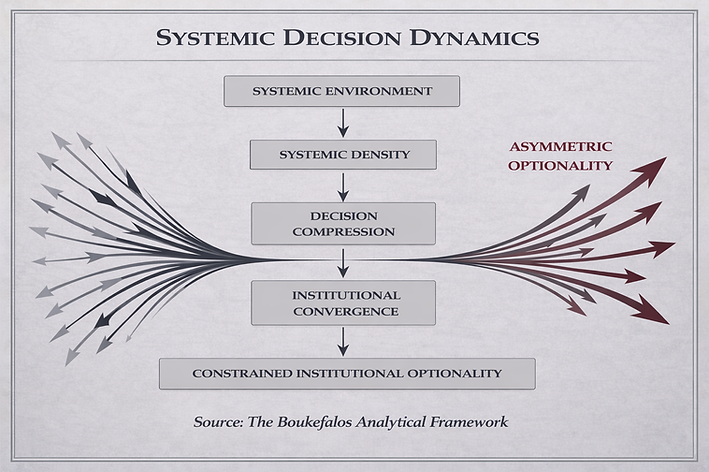
The structural mechanism underlying this dynamic can be illustrated as follows.
2. Core Structural Mechanism
The Boukefalos framework is built around a simple structural mechanism.
Increasing systemic density compresses institutional decision environments, narrowing the corridor of defensible options available to policymakers.
3. Core Decision Mechanism
Increasing systemic density compresses institutional decision environments.
As informational pressure rises, the time available for evaluation shrinks while legitimacy constraints remain intact. Institutions therefore converge on a narrower set of defensible choices, creating a corridor of acceptable options that shapes strategic outcomes.
4. Systemic Decision Dynamics
Institutional decision-making does not occur in a neutral environment.
Political institutions operate under simultaneous pressures: informational overload, legitimacy constraints, and time limitations. These pressures interact to compress the decision space available to policymakers, shaping both the speed and structure of institutional responses.
5. Adversarial Manipulation
Strategic actors can exploit compressed decision environments.
Rather than persuading institutions directly, influence operations often focus on shaping which signals become salient within the institutional information environment. By amplifying ambiguity or structuring competing narratives, adversaries can steer institutional attention within the corridor of defensible options.
6. Institutional Response
When decision environments become compressed, institutions tend to prioritise options that minimise reputational exposure and institutional risk.
This dynamic produces predictable convergence patterns in policy responses, particularly during crises or rapidly evolving geopolitical situations.
7. The Boukefalos Analytical Framework
The Boukefalos framework integrates systemic pressure, institutional decision dynamics, and strategic manipulation into a single analytical model.
By examining how density, compression, and institutional convergence interact, the framework provides a structured approach to analysing geopolitical competition and institutional decision behaviour.
The Boukefalos Analytical Framework provides a structured approach to analysing institutional behaviour under conditions of systemic informational density.
By examining how compression, legitimacy constraints, and information environments interact, the framework helps identify patterns in geopolitical decision-making and strategic competition.
It is intended as a tool for analysing how institutions behave when complexity exceeds the normal capacity of political decision systems.